Shane Mccrae Reading From in the Language of My Captor
Volume Review
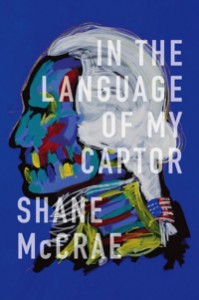 Shane McCrae, author of Mule (2010), In Canaan (2011), Claret (2013), Forgiveness Forgiveness (2014), and The Animal Too Large to Kill (2015), has created a glowingly powerful book in his most recent drove, In the Language of My Captor, and to approach it means to do so carefully. Everything from its content, largely concerned with black experience in America throughout history, to its personal sincerity and dash, raises the book above a stock-still reading feel. The resulting poems crusade multiple thoughts at once, and for that I am grateful.
The chronological nature of the volume'due south personas (from the Ceremonious War era through the beginning of talking films), interspersed with contemporary kickoff person perspective, accounts for a narrative of African Americans hovering all besides about violence throughout American history. Not surprisingly, McCrae admits in an interview with The Rumpus that he prefers to write from multiple perspectives, including historical ones, as the reader volition observe in his latest book:
I retrieve that the moment nosotros're living in offers the all-time opportunity we've had in a long time in that a lot of things having to do with identity politics are being talked most in poems . . . But, if your business concern is getting away from the confessional blazon of poem, so talking about history, while non talking about it in a reflexive, kickoff-person way, is one means of doing so.
To accomplish this not-confessional identity politics, In the Language of My Captor offers a mix of historical and semi-fictional persona poems, all of which repeat one some other in the larger implications of race and violence in the volume. The unnamed person in the zoo cage (office one); Jim Limber, the adopted mulatto son of Jefferson Davis (role two); and Banjo Yes (role three) inhabit the book in their own spaces, after which the fourth section brings these various voices together. "While the very basic historical events recounted in these poems did happen," McCrae writes in an writer's note for the Missouri Review, "I fabricated up everything the speakers say. I wanted to do my very small office to at least present the fact of Jim Limber." Through his docupoetic figuration of Jim Limber, McCrae investigates the infinite betwixt detest, tolerance, and love, and in a manner that gives each its consideration so that the reader can better empathize their complexities.
Taking for case "Jim Limber the Adopted Mulatto Son of Jefferson Davis Cannot Afford to Make Demands of Love," the reader ends on a touching note from Jim Limber regarding his adoptive father, Jefferson Davis: "that's how I know he / Loves me considering he don't heed what he shows me." It would exist likewise simplistic to explain this moment as one of intersection between racism and love, for those vectors are in constant motion in McCrae'south book. This tender moment, still, compounds with the weight of before lines such as, "it'southward something like a Ne- / gro cannot listen like the folks he owes / A duty to and that's a groovy relief." Something is lost from this love, as racism taints this act of confiding in Limber with its categorical or hierarchical thinking—who tin can and cannot listen.
Only perchance an act of dear such as confiding will remain loving regardless. McCrae offers such open readings, even in the pocket-size gaps within lines of the same verse form:
A lot of the fourth dimension he talks to me well-nigh
Things he don't talk he says to nobody
About he says information technology's something similar a Ne-
gro cannot heed . . .
There is bachelor room for a reader to do a myriad of things with the typographical spaces, from reading them equally unsaid punctuation, to leaving room for additional words from the reader's heed. For case, "Things he don't talk he [never] says to nobody / Most he says [to me] information technology's something," reads as possible co-ordinate to McCrae's cues. There are other possibilities, and these become to testify the multivalence of McCrae's poems swinging toward the loving positive, and then back again toward the inherent hate of racism. The shifting meaning, line by line and poem by poem, attests to McCrae's first-class care of race and language. Through its poetics, perhaps McCrae's book has something to teach the states near dash of idea in the face of divisive moments.
The inclusion, nonetheless, of personal business relationship, primarily in part two, "Purgatory: A Memoir / A Son and Father of Sons," balances the book's outside influence of personas and at the aforementioned time risks the speaker'southward feel, whether McCrae's or his invention's. These experiences naturally tie in with the other parts of the book and its broader strokes, as when the male child speaker in part two admits of himself, "When I was a child, I was willing, even eager, to let everyone practise annihilation they wanted to me, and then long equally they didn't hurt me." Much similar Shane McCrae's speaker entering deeper into the wood, "fear compelled me towards the things I feared" in reading this book. Its often casual accounts of violence and oppression give it a surreal feeling at times, such every bit in the prose section of part two:
The showtime thing my grandpa did—that was the way my grandmother always told the story—the get-go thing he did after nosotros moved into our new firm was throw me into a wall, the living room wall, the stretch of wall, maybe four feet wide—in a few years he would hang a painting . . .
McCrae then describes the various paintings that go upwards on that wall afterwards, without farther mention of the grandfather's act of violence. The understated and direct quality of this and office one's chat between a zookeeper and a caged man (perhaps alluding to Ota Benga, a homo bought past African slave traders and exhibited in the Bronx Zoo in the early 1900s) calls out the horror even more than in the reader's imagination, and we go involved at the level of the voyeur or more. Throughout In the Linguistic communication of My Captor, McCrae involves the reader in the underlying racism that necessitates the book, and sometimes this happens directly, as in the "Banjo Yeah Asks a Journalist":
I didn't marry none of them white women
Because I was a /What did you say a free black man
The employ of the second person intensifies the reader-implication here, making a reader assume the journalist, another course of the voyeur. The reader volition likely have questions coming into the book—possibly in reaction to the title, author, and their own experience—and in the process of reading, those questions have the form of dialogues and relationships, in which no one can answer with finality. Not even the end of the book can sift through these dialogues:
. . . /Daughter historic period iv
She thinks it might he [the old man in the waves] might be real she shouts Hello
And after there'south no answer answers No
Ultimately, what I well-nigh capeesh in this book is its experiential reading and its nuance of thought. It encourages the reader to take an internal conversation on racism, on hate and beloved, and on the need to avoid violence. In the Language of My Captor is a thoughtful book that causes its reader to retrieve on the level of care. Challenging while inviting with its imaginative abilities, McCrae has written a book that is a valuable read for anyone.
Well-nigh the Reviewer
Cole Konopka is a poetry MFA candidate at Colorado State University, where he serves every bit the assistant director to the Artistic Writing program's reading series. His work can be found on Gramma Weekly.
Source: https://coloradoreview.colostate.edu/reviews/in-the-language-of-my-captor/
0 Response to "Shane Mccrae Reading From in the Language of My Captor"
إرسال تعليق